



Built Instructions
We like to think obedience comes from rules, from authority, from enforcement. But long before any of that, we learned how to behave from space. From corridors that told us where to walk. From rooms that decided who could see and who could be seen. From layouts that made certain actions feel natural and others feel out of place.
Michel Foucault wrote about discipline as something that works best when it becomes invisible — when power no longer needs to announce itself because it has already reorganized the environment. Architecture was one of its most effective tools. Not because it’s imposed, but because it’s repeated. Because it arranged. Because it trained us slowly enough that we forgot we were being trained at all.
Before there were cameras, before there were access cards, before there were systems deciding who belonged where, there were spaces that quietly taught us how to obey.
We learned it in schools, where corridors moved us in single directions and classrooms positioned bodies toward authority. We learned it in offices, where visibility became a form of self-correction and privacy was framed as inefficiency. We learned it in housing, where thresholds separated public from private, acceptable from unacceptable, inside from outside. Nothing dramatic. Nothing violent. Just consistent spatial instruction.
This is the part that often goes unnoticed: architecture rarely tells us no. It tells us this way. And we follow.
Foucault called this normalization; the process by which behavior becomes regulated not through force, but through spatial expectation. When a space is designed well enough, we don’t feel constrained. We feel aligned. We move as intended because deviation feels awkward, exposed, and incorrect.

George Orwell imagined control as something watchful and explicit, eyes everywhere, authority always present. But what architecture demonstrates is something quieter. We don’t need to be watched constantly. We only need to know how we are supposed to behave. Once that expectation is internalized, the space no longer has to enforce anything.
We correct ourselves.
This is where architecture becomes especially powerful. It doesn’t rely on surveillance; it relies on anticipation. The knowledge that certain actions will feel wrong, even if no one stops us. The knowledge that some spaces are not meant for lingering, for questioning, for deviation even if no sign says so.
Jacques Derrida argued that structures create meaning by exclusion that order is never neutral, because something always has to be left out for clarity to exist. Architecture does this constantly. It clarifies circulation by eliminating alternatives. It creates legibility by suppressing ambiguity. It produces calm by removing friction.
In doing so, it also produces compliance.
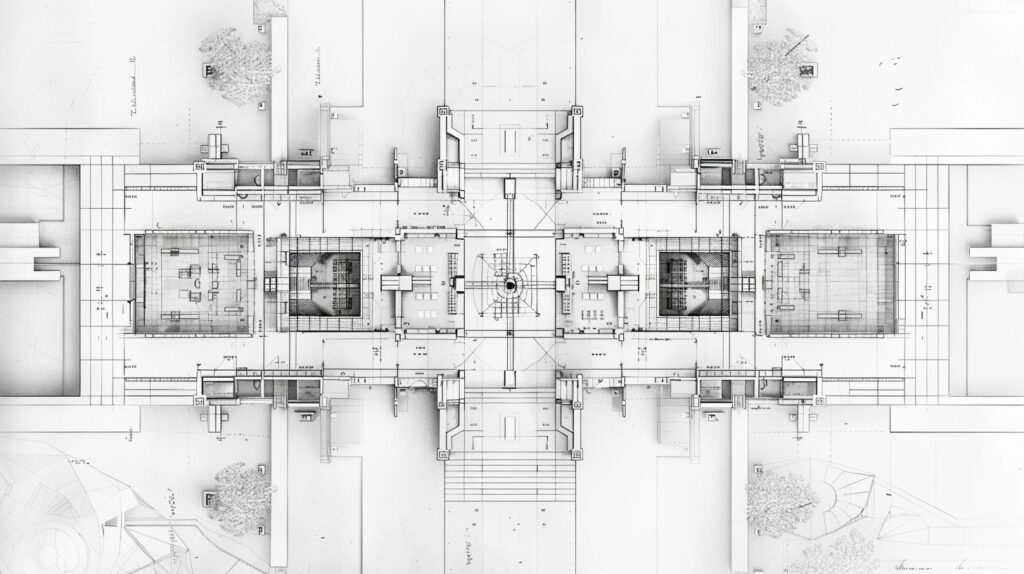
As architects, we are taught to treat clarity as a moral good. Clear plans. Clear circulation. Clear hierarchy. Clarity is framed as care, as responsibility, as professionalism. But clarity is never neutral. Every act of clarification is also an act of removal. Every resolved space eliminates alternatives before anyone has the chance to choose them. What we call legibility is often the quiet enforcement of a single reading of space, where other behaviors, other rhythms, other ways of being are made to feel incorrect, inefficient, or out of place before they can even be attempted.
Over time, we stop questioning those boundaries. We accept them as natural. We forget they were designed.
This is how obedience becomes spatial rather than ideological. We don’t obey because we agree. We obey because the space has already decided what makes sense. And because resisting that logic requires effort, social effort, emotional effort, spatial effort, most of the time, we don’t.
We comply without noticing.
What’s unsettling is how early this training begins. Long before we encounter explicit systems of control, we are already fluent in spatial behavior. We know how to line up. We know where not to sit. We know how long we are allowed to stay. We know when a space is not for us even if it never says so directly.
By the time technology enters architecture, this obedience is already embedded. The systems don’t have to teach us from scratch. They simply automate what space has already taught us.
And that is the quiet truth we often avoid as designers: architecture did not lose its innocence when technology arrived. It prepared the ground for it.
Space taught us how to obey long before anything else had to.